
California Opportunity Zones
The Opportunity Zones (OZ) program is a federal tax incentive established by the 2017 Tax Cuts and Jobs Act (TCJA) to encourage investment in economically distressed communities. Investments made by individuals through special funds in these zones would be allowed to defer or eliminate federal taxes on capital gains. The One, Big, Beautiful Bill Act (OBBBA), signed into law on July 4, 2025, as Public Law 119-21, made the OZ program permanent with 10-year redesignation cycles and introduced structural changes, including stricter criteria for future OZ designations.
The Opportunity Zones 2.0 designation process is complete and new Opportunity Zones (OZ 2.0) designations become effective January 1, 2027. Existing Opportunity Zones (OZ 1.0) remain in effect through December 31, 2028. For more information on California's OZ 2.0 nomination process, visit the GO-Biz Opportunity Zones website.
Additional federal guidance and resources are available on the U.S. Department of the Treasury Opportunity Zones website.
Opportunity Zones 2.0
Background
Opportunity Zones 2.0 (OZ 2.0) refers to the permanent renewal and enhancement of the Opportunity Zones program, first enacted in December 2017. Investments made through special funds in these zones are allowed to defer or eliminate federal taxes on capital gains. Under the original law, the program was set to expire on December 31, 2028. Public Law 119-21, signed into law on July 4, 2025, makes the program a permanent feature of the Internal Revenue Code while updating eligibility criteria, tax incentives, and compliance requirements. OZ 2.0 designated tracts will become opportunity zones on January 1, 2027, and are scheduled to expire in ten years when OZ 3.0 designations will take effect.
Under OZ 2.0, the statute allows the Governor to nominate up to 25 percent of the 2479 tracts that were eligible based on the updated criteria as opportunity zones, with the U.S. Department of the Treasury making the final designation.
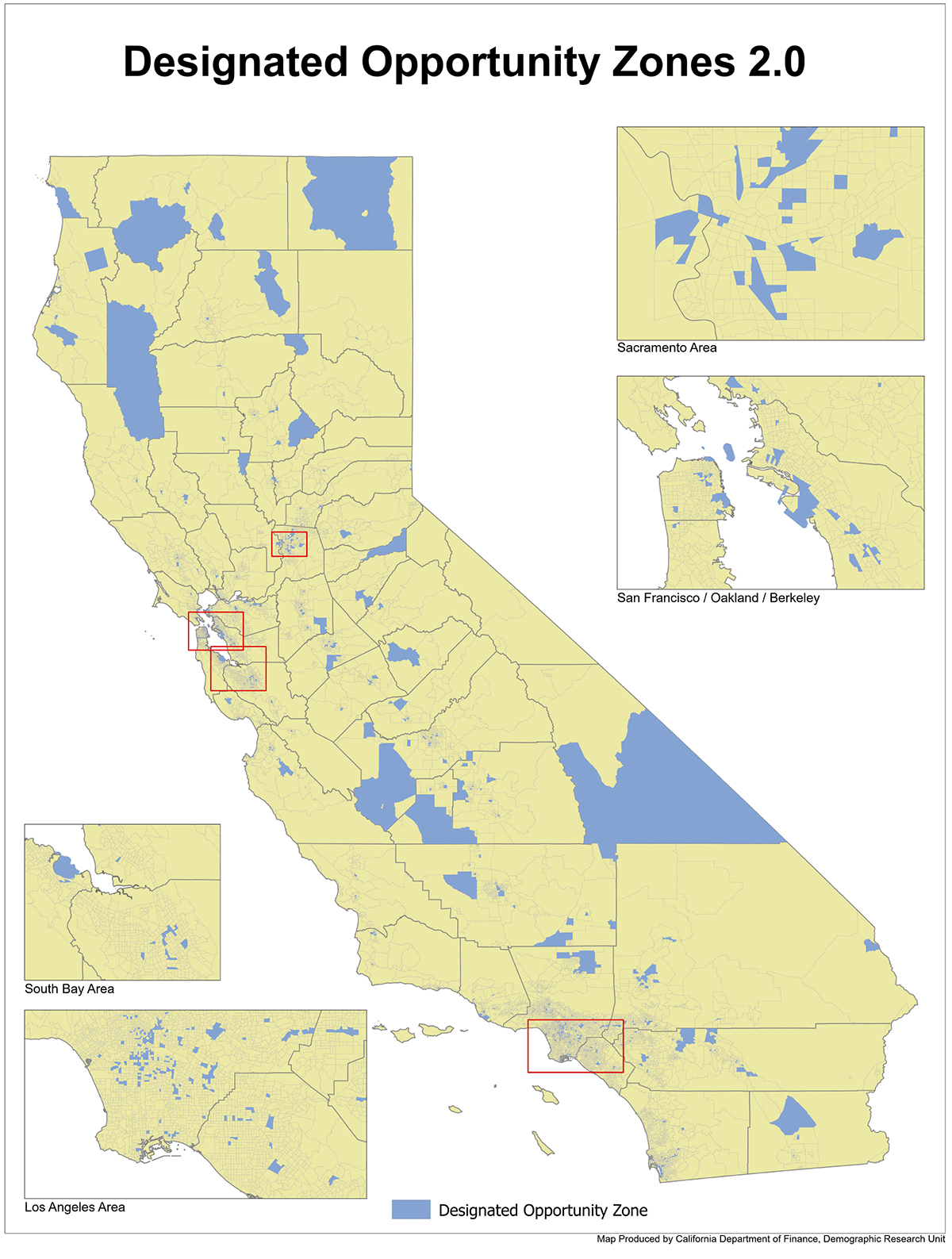
In fall 2026, Treasury certified the Governor’s OZ 2.0 nomination of 620 census tracts encompassing an estimated 2.6 million people in the 55 counties that had at least one eligible tract. This is about 25 percent of the population in all eligible tracts.
The Department of Finance (Finance) and the Governor’s Office of Business and Economic Development (GO-Biz) jointly oversaw the state’s process for identifying OZ 2.0 tracts. The nominations followed several months of outreach, local government recommendations, public comment, and analysis of U.S. Census Bureau data.
Preliminary Designations
Finance evaluated the 2,479 eligible census tracts using a composite scoring framework based on the Census Bureau 2020-2024 American Community Survey 5-year estimates to identify tracts with the greatest socio-economic need.
- Priority Consideration Criteria:
- Poverty — measures the concentration of residents living below the poverty line and is a primary indicator of economic hardship.
- Median Family Income — measures how incomes compare to the surrounding area, capturing both economic disadvantage and financial capacity.
- Renter Occupancy and Rent as a Percentage of Income — measures housing cost and availability, based on the share of renter households spending 35 percent or more of income on gross rent, indicating financial strain.
- Crowding — reflects constrained housing conditions (more than one person per room), often driven by limited housing supply or affordability pressure, and is associated with housing instability and displacement risk.
- Unemployment — captures limited access to jobs and labor market challenges.
The resultant score was combined with GO-Biz’s evaluation of 1,232 tract recommendations submitted during the GO-Biz-led Local Authority Recommendation Form (LARF) process. It encompassed a variety of factors designed to measure the developmental readiness and local economic impact of eligible tracts that received LARF comments. The Finance and GO-Biz metrics were used to select 560 tracts for an initial recommended list provided to the Governor’s Office and published for public comment on August 3, 2026.
Comment Period
Through August 28, 2026, Finance received robust public comments:- 3,754 comments were received regarding 863 individual census tracts.
- Comments came from a total of 861 individuals, cities, counties, elected officials, nonprofit organizations, and others.
- 37 percent of the comments were on tracts that were included on the initial recommended list and 63 percent were on other eligible tracts.
Final Nomination Designation
Recognizing economic need, developmental readiness, and community engagement, the final nomination list of 620 tracts reflects a selection process that balanced the contributions of the Finance-derived score, the LARF process, local preferences, and public comments.
- Local guidance was followed, when possible, by considering recommendations expressed through the LARF and preference process while balancing against state priorities such as economic need, geographic equity, and adequate incorporation of public comment input.
Opportunity 2.0 Designated List
- Download a List of the OZ 2.0 Designated Tracts for California.
- View an Interactive Map of the OZ 2.0 Designated Tracts for California (cacensus.maps.arcgis.com).
- Download a Non-Interactive Map of the OZ 2.0 Designated Tracts for California (34 inches x 44 inches).
- Visit the GO-Biz Opportunity Zone website.
Opportunity Zones 1.0
Mapping Tools
- Determine if a property address is located within the boundaries of an Opportunity Zone by using the U.S. Department of Treasury CDFI Fund's NMTC Public Viewer. (amis.cdfifund.gov).
- CPBS has produced an interactive map (properties.zoomprospector.com) containing Opportunity Zones and other features such as hazard zones, electric utility coverage, and broadband access.